
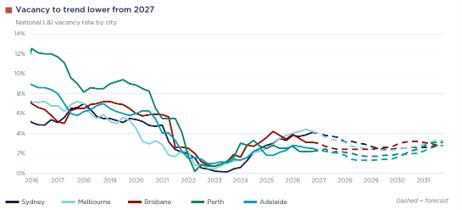
Australia’s industrial vacancy is forecast to fall across major markets from 2027, reaching its lowest point in 2029 at around 2.2%, according to new research from Cushman & Wakefield. As the window of choice narrows and new supply remains constrained, occupiers are resetting their property strategies around efficiency and productivity.
The Occupier Reset report found the shift is already evident in leasing behaviour, with gross take-up reaching almost 3.4 million sqm in the 2026 year-to-date, but net absorption sitting at under 770,000 sqm. This gap shows most leasing is being driven by relocations, consolidations and upgrades rather than expansion.
According to the report, up to 3.1 million sqm of new warehouse space could be delivered between Q3 2026 and Q4 2027, but around 1.1 million sqm will only be activated following a pre-commitment. Of the remaining pipeline, 56% is already pre-committed.
Net absorption is expected to recover from mid-2027 as major pre-committed expansion facilities are completed, rising from 1.1 million sqm in 2026 to 1.9 million sqm in 2027. However, absorption will remain below the 10-year average.
Luke Crawford, Head of Logistics and Industrial Research, Australia at Cushman & Wakefield, said the report finds market conditions are pushing occupiers to focus on maximising the capacity and productivity of existing spaces.
“Leasing activity remains active, but the underlying behaviour has changed. The question is no longer just whether a business needs more space, but whether its existing portfolio is fit for the next phase of growth.”
Looking ahead, national vacancy is forecast to rise in several markets from 2029 as development conditions improve. However, conditions are not expected to be uniform across the country, with tightening levels set to vary by city and precinct.
Brisbane, which began falling in 2026, will continue to do so, while Melbourne recovers from a higher vacancy rate. Infill and land-constrained locations are forecast to tighten earlier, once current speculative supply is absorbed, and greenfield precincts like Sydney’s Outer West and Melbourne’s South East are expected to remain higher for longer.
“For occupiers, that means headline vacancy may increasingly overstate the level of genuine choice, particularly for businesses requiring modern facilities in tightly held locations.”
Industrial development pipeline constrained until 2029
Australia's industrial development pipeline is expected to remain constrained until closer to 2029, as challenging development economics delay project commencements.
The report forecasts speculative completions will fall to their lowest level since 2021, with almost 60% of the pipeline concentrated in three submarkets.
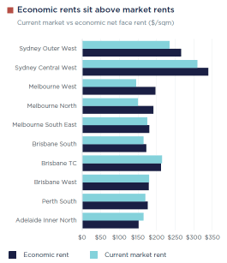
Rising construction and funding costs have pushed economic rents 10-25% above prevailing market rents in several key markets, delaying the expected recovery in development feasibility from early 2027 to closer to 2029.
David Hall, Head of Commercial Real Estate - ANZ , Cushman & Wakefield said the underlying demand drivers remain, but the way businesses translate that demand into property requirements is changing.
“Occupiers are now basing decisions on total fulfilment cost and customer reach, rather than rent alone. Logistics operators are consolidating into fewer, larger hubs, manufacturers are chasing power-enabled sites to support automation, and data-centre-related businesses are clustering around established precincts.
“For landlords and developers, the assets that win will be the ones that help tenants cut whole-of-business costs through building functionality and ESG performance.”
